
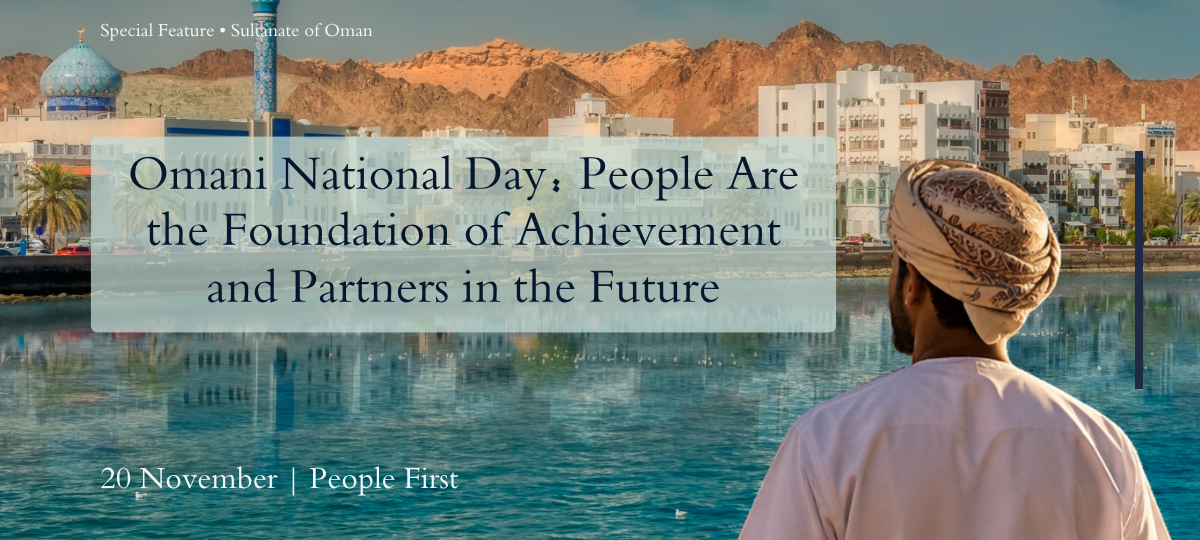
Omani National Day falls on November 20, marking an occasion on which we reflect on Oman’s rich history and renew our commitment to continued progress. On this day, we celebrate a nation whose flag was raised by the Founding Imam, Ahmad bin Said Al Busaidi, in 1744, and we also celebrate the work, knowledge, and creativity that Omanis contribute today to the ongoing renaissance under the wise leadership of His Majesty Sultan Haitham bin Tariq—may God protect and preserve him.
One of the most important measures of a nation’s progress is its investment in its people; they are both the goal and the means of development. The Sultanate of Oman has witnessed continuous efforts to develop the capabilities of its citizens, prepare them for a rapidly changing job market, and enhance their opportunities for participation across various sectors. In 2026, indicators reflect progress in the implementation of the National Employment Plan; the Ministry of Labor announced the creation of 53,525 employment, replacement, and training opportunities linked to employment as of the end of September this year, representing approximately 89% of the annual target of 60,000 opportunities. The results included 41,024 employment and job placement opportunities and 12,501 employment-linked training opportunities. The employment and placement opportunities were distributed as follows: 14,235 in the public sector and 26,789 in the private sector, while the training opportunities included 2,370 in the public sector and 10,131 in the private sector. These are interim figures as of the end of September 2026. Praise be to God for this, but we still aspire to achieve more for the benefit of job seekers, in order to activate the role of institutions, companies, and individuals in providing and supporting employment initiatives.
This progress comes within the framework of the high directives of His Majesty Sultan Haitham bin Tariq, which emphasized accelerating the implementation of the 2026 Job Seekers Employment Program, with a target of creating 60,000 opportunities. The directives also included the allocation of 50 million Omani rials to projects with economic and investment returns that generate job opportunities, by increasing the allocations for the Governorate Development Program under the 11th Five-Year Plan to 270 million rials. These directives underscore that employment and the development of national capabilities are development priorities, and that achieving them requires an effective partnership between the government, the private sector, and training and human resources institutions.
These efforts are in line with Oman Vision 2040, which has made people and society a national priority and linked capacity development to building a competitive economy based on innovation, integrated roles, and equal opportunities. In the area of labor market and employment priorities, efforts include developing digital employment platforms, establishing an integrated national system for capacity building and talent management, and supporting self-employment. The year 2025 also saw work on initiatives including a competency framework, individual and organizational performance measurement, professional standards, organizational innovation, and change management—tools that help make competency development an ongoing organizational practice, rather than merely sporadic training programs.
The Vision’s indicators confirm that significant work lies ahead in the coming phase: increasing the proportion of skilled workers in the private sector and boosting the share of Omanis in newly created jobs are among the Vision’s targets. This requires aligning education with market needs, developing practical training, raising labor productivity, and opening clear career paths for young people. Sustainable employment is not achieved through hiring alone, but by building the skills the economy needs and creating work environments that preserve dignity and support growth and development.
In 2025, inspiring Omani role models emerged in the field of human resources. Dr. Saeed bin Ali al-Hassani received a grant from the Omani Society for Human Resource Management for the best academic research in this field, in recognition of the role of research in understanding challenges and providing practical solutions. Our colleague, Mr. Faisal bin Ali al-Ma’mari of “OQ Gas Networks,” also received the Best Human Resources Manager Award in recognition of his leadership and initiatives in strengthening organizational culture. The awards also included Mr. Saeed bin Abdullah Al-Manzari, CEO of the “Izkaa” Group, in recognition of his leadership, which has contributed to advancing human resources practices. These examples demonstrate that the development of human capital is a shared responsibility among researchers, leaders, specialists, and institutions.
Therefore, the responsibility for addressing employment issues should not rest solely with the government. Business owners, entrepreneurs, companies, and institutions specializing in human resources can contribute in practical ways: clearly defining job roles and required skills; offering training coupled with real opportunities; providing practical training opportunities for graduates; and reviewing hiring requirements to ensure that promising talent is not unjustifiably excluded. Specialists can also provide career guidance, help job seekers improve their resumes and prepare for interviews, and support small businesses in developing more effective hiring and development practices.
Social responsibility begins with viewing job seekers as individuals with aspirations and abilities, not as mere numbers on a list. It also begins with listening to employers to understand their needs, then bridging the gap between the two sides through training, guidance, and partnership-building. When organizations collaborate on training and mentoring, and hire based on competence and a willingness to learn, social responsibility translates into a tangible impact on individuals’ lives and on the economy’s productivity.
With this in mind, and in celebration of this national occasion dear to every Omani, we are working to launch a community initiative aimed at helping to address some of the challenges related to employment and job seekers by leveraging our expertise in human resources to serve the community and enhance the readiness of national talent. Details will be announced shortly, and we hope this will be a practical step that opens doors for collaboration among individuals, institutions, and the private sector.
Celebrating National Day is not complete with merely recalling our achievements; rather, it is renewed when we transform a sense of belonging into action, expertise into service, and opportunities into genuine paths for growth. In every Omani talent that finds its way to learning, work, and productivity, the meaning of investing in people is embodied, and Oman takes another step toward a future worthy of the aspirations of its people and the vision of its nation.